
Human–AI Co-Working
The Soul, the AI Machine, and the Gap Year


The AI is here, here to stay. In that light, we humans will need to figure out how to co-work, co-live, co-plan, co-habit with the AI. The question of how best to do that, to retain the uniqueness and wonder of what makes the human person so remarkable, is one of the most profound questions pressing contemporary society. The increasingly wild and unregulated uptake, the rapidly increasing energetic frenzy of the human embrace of the AI, requires an much greater sense of urgency and a much more thorough reflection by humans as to what the “relationship” of humans and the AI should be, in the best interests of human society and the sustainability of the best qualities of humanity.
What is AI
AI works by using large amounts of data to recognize patterns and make decisions and predictions. AI decisions are fundamentally different from human ones, relying on structured data, logic, and mathematical models, whereas human decisions are influenced by intuition, emotions, empathy, context, and values. While AI excels at speed, consistency, and handling massive data, it lacks human creativity, complex problem-solving skills in ambiguous situations, and genuine ethical understanding.
The Soul/Machine Complex
When I say someone has soul, I am talking about soul not in the context of religion. Rather, I’m pointing to something far deeper and internal to the self: a way of living that feels alive, resonant, and connected to what matters most in the human experience. Soul is authenticity. It is an emotional richness. It’s the spark of aliveness that turns routine into meaning, and performance into presence. It’s what makes a piece of music stir us, or a story stay with us long after it ends. And it is a unique aspect of what it means to be human, an aspect machines (the AI) is absolutely incapable of; at least for now.
But what does soul mean in an age where more and more of our work, thought, and even creativity is shared with machines?
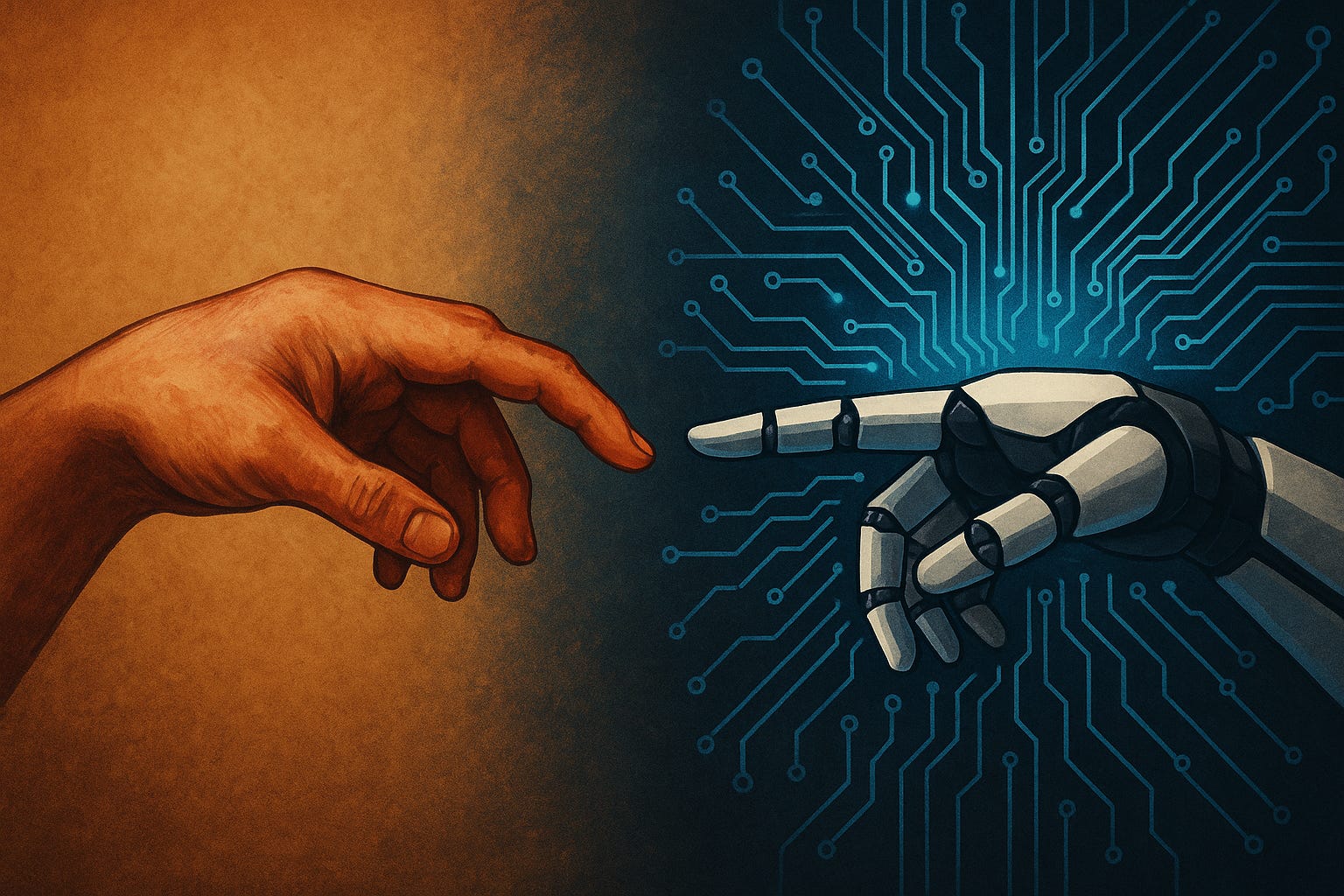
What Soul Really Means
Soul reveals itself in three dimensions.
· First it is a depth of being. Humans carry an interior life of memory, longing, intuition, and contradiction. That’s what makes our words, our art, and even our silences resonate. AI, however sophisticated, does not share this interiority. It generates patterns; it does not feel. It can simulate the gestures of soul, but it does not experience them.
· Second, it is the connection between mortality and meaning. Our awareness of death infuses our lives with urgency. We know that love, beauty, and moral choice matter precisely because they are fleeting. AI doesn’t age or die. It cannot risk, sacrifice, or cherish in the way humans do. Its outputs are mirrors of meaning, not the origin of it.
· Third, it is wholeness through contradiction. Humans are paradoxical beings. We fail and get up again. We turn wounds into wisdom. Our contradictions are not bugs in the system; they are the source of our deepest grace. AI, designed for coherence and prediction, lacks this existential friction. It cannot stumble into compassion or turn suffering into art.
And that is the heart of it: AI cannot carry soul, but it can amplify it.
Where the Gap Year Fits
This is where the Gap Year becomes more than just a detour between high school and college. The lived experiences and broad and deep understanding and meaning of how the World works, flow from the facts and methods practiced in school and then applied in the challenging experiences of the real world.
School alone can’t teach meaning and purpose.
It is in the personal confronting of lived circumstance that creates the motivation and driven inquiry to “figure it out” that transforms the dependent adolescent into the independent self-agent adult. Schools provide facts, context, ideas and academic skills. These are foundational for developing a vocabulary of expression and siloes of knowledge. But the nature of the schools’ curriculum, as 150 year old inventions of a different era, that constrain self-reflection, the range and depth of the understanding the interconnectedness and dependency within and between human systems and Nature. They adapt and evolve slowly, within disciplines driven by specialization through compliance with the college admissions expectations. The expansiveness of the students curiosity at this profoundly significant stage of cognitive development is squelched or dampened through standardized pre-college criteria and social custom and policy. Schools can do just so much without a radical redesign. And in a messy world increasingly defined by machines that don’t have a soul while having a hypnotic pull and as such sublimating the individual to believe in its truth, these young individuals have little opportunity to know themselves, and what is in their souls..
So it is through the Gap Year experiences before college where the profound space for young people to discover and deepen their sense of their own soul in a world is found;
And so, in the future world, the AI will increasingly handle the predictable, the efficient, the scalable it is so good at. What will matter most in human life however is what cannot be automated: authenticity, empathy, moral imagination, and the ability to wrestle with contradictions and ambiguity. A Gap Year—done with intention—gives young people a living laboratory in which to develop exactly those capacities.
1. Authenticity through lived experience. Traveling, working, or serving in communities beyond one’s comfort zone reveals truths that no screen or algorithm can substitute. A Gap Year helps strip away performance and invites students to discover who they are when grades, status, and comparison fall away.
2. Meaning through mortality and risk. Whether it’s trekking through new landscapes, facing the discomfort of cultural difference, or engaging in work that matters to others, Gap Year experiences bring the reminder that life is fragile and precious. They awaken the urgency of choosing wisely how to live.
3. Wholeness through contradiction. Students encounter failure, uncertainty, even loneliness—and learn to transform those struggles into resilience, compassion, and self-knowledge. These tensions cultivate soul, not polish.
In short, the Gap Year is not an escape from the machine age; it is preparation for it. By cultivating depth, vitality, and authenticity, students return to college and career ready not just to use AI, but to anchor its use in human soulfulness.
Humans Set the Why, AI Accelerates the How
The best model of co-working is simple:
Humans set the why.
AI accelerates the how.
Humans provide depth.
AI extends reach.
But without soul—without the grounding of lived experience, values, and meaning—the partnership collapses into efficiency without direction, leading into chaos and dysfunction.

This is why the Gap Year matters more now than ever.
It creates the conditions for young people to encounter the depth of their own being before immersing themselves in the rapid and specialized currents of higher education and AI-driven careers. It gives them the tools to anchor meaning, even as technology accelerates. It is in the students appreciating and developing the thoughtful power and regard for the balance of nuance, critical thinking, ambiguity, ethics and leadership were they learn to be much more capable in guiding the AI in generating it’s best capacities in the interests of the the future of humanity.
Machines can amplify our soulfulness—but only we can provide the soul.
That is the gift a Gap Year helps uncover. That is the gift only humans carry. That is the soul. AI is here, here to stay. In that light, we humans will need to figure out how to co-work, co-live, co-plan, co-habit with the AI. The question of how best to do that, to retain the uniqueness and wonder of what makes the human person so remarkable, is one of the most profound questions pressing contemporary society. The increasingly wild and unregulated uptake, the rapidly increasing energetic frenzy of the human embrace of the AI, requires a much greater sense of urgency and a much more thorough reflection by humans as to what the “relationship” of humans and the AI should be, in the best interests of human society and the sustainability of the best qualities of humanity.
Jake Horne